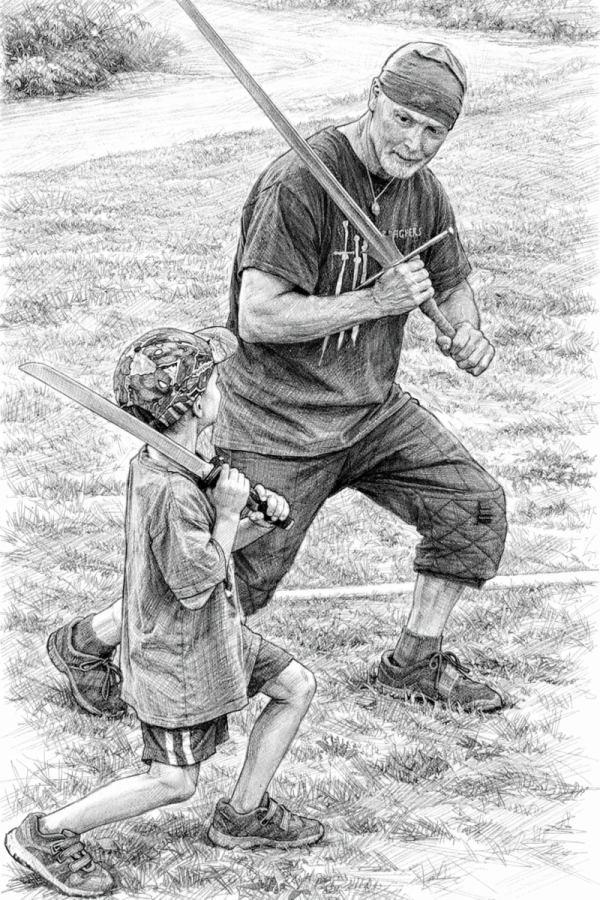
I am watching my first grandson play with his uncle. The play is raucous and chaotic—his uncle wrestling with him, throwing him around, the boy jumping onto his uncle’s back. Both are laughing, fully engaged. Periodically, the uncle admonishes, “Hey—too rough!” or “Let’s go over here now,” before picking up Nerf guns and diving back in.
I chuckle at this. It is satisfying—right and good—to see them connecting through roughhousing. Modern experts have begun to recognize how important this kind of play is (see the work of Jaak Panksepp on rough-and-tumble play). It teaches a boy limits and hierarchy, even as he is allowed to go wild—to run with the wolves.
Roughhousing is the instinctive beginning; martial arts are its disciplined continuation.
A boy left to his own devices will expand his territory until he owns the world. Drapery becomes jungle vines. Dogs and cats become prey. By wrestling with a father or uncle, boys discover—experientially—that they are not the biggest lion in the jungle. They learn what it feels like to be hurt, to hurt others, and to take responsibility for their actions.
My son-in-law, my grandson’s uncle, became a father himself a few weeks ago. He is also a soccer player, and it is magnificent to watch him run at full tilt down the field, holding nothing back—expressing his prowess freely. Yet within that movement, there is restraint and purpose. I hope that incredible energy is not stifled over time. His son needs to see it.
These days, many men pull back from this kind of expression. They restrain themselves from being “too good” or “too capable,” or stop exploring their potential beyond the minimal. This so-called “crisis in masculinity” appears frequently in the news. Recently, Canada initiated a national “Men and Boys’ Health Strategy to address suicide rates, mental health, and harmful stereotypes.” The question is whether such efforts cultivate strength—or merely attempt to suppress its excesses.
You cannot shame the maleness out of a boy. You can break him, enrage him, or hollow him out—but you cannot refine him that way.
At the same time, the frustration behind these concerns is real. Men commit more violent crimes. Men can be coarse, uncaring, even brutish. Men also suffer—from suicide, addiction, and loneliness.
I find myself remembering the many beginner classes I have run over the years. Most who came through them were men and boys.
From that experience, I have come to believe that martial arts offer one of the few remaining structured environments where boys and men can develop disciplined masculinity through experience rather than abstraction.
Few people actually practice martial arts. Worldwide, perhaps only 1 to 5 percent of the population trains in them, and roughly 75 percent of those are men. I once assumed those numbers were far higher. So when I speak about men in martial arts, I am speaking about a small, self-selected group. Still, the lessons learned there are transferable.
Beginners come in many forms—not only physically, but in motivation. Some arrive out of curiosity or fantasy. Others come for more serious reasons.
In my classes, only about 10 percent have been women, though this varies by region. I will speak about women in a later piece. For now, I focus on men and boys.
When new students walk through the door, they are confronted with conditions. Shoes may not be worn. Meditation may precede practice. Opponents bow or shake hands. You bow when entering and leaving. Some men resist this. “I don’t bow to anyone,” they say, as though respect were degradation.
Some enter with something to prove, or anger to discharge. Others shy away from exposure—fearful of striking or being struck. Some are simply looking for a way through fear.
Over time, practice moderates these extremes. Angry men develop self-control. Timid men gain resolve. Whether by design or by consequence, the training produces this effect.
There is a hierarchy in practice, whether implied or formal. There will always be someone better than you. Properly encountered, that reality builds humility instead of resentment. It forces self-examination, diminishes grandiosity, and provides direction through example.
Practice provides a code—a set of values to aspire to. These are not unique to martial arts. They are embedded in reality itself, supporting survival and cooperation: honesty, integrity, honor, benevolence, kindness, humility.
As skill develops, the code, the conventions, and the lived experience of facing fear and chaos build camaraderie—and a way of living. Brotherhood strengthens the resolve to live by that code.
Practice also teaches responsibility. If an opponent strikes you, something in your defense failed. If you strike unfairly or in anger, you must make it right. These are two sides of the same coin.
Martial practice is not passive. You are expected to act, even as you are reminded that the highest expression of the art is to resolve conflict without fighting.
Facing a skilled opponent requires something of you. You will feel fear. The practice is learning to remain focused in its presence and to adapt when something unexpected occurs. These are not abstract qualities—they are built into training. And they are qualities our young men need.
I will say this plainly: men and boys need this kind of experience in some form. They grow through example, experience, clear standards, honest feedback, and accountability—and martial practice provides this.
If only a small percentage train, then other paths must carry similar lessons. These can be found in intellectual pursuits, religion, the arts, or any disciplined practice—if one looks deeply enough. This code of honor must be reintegrated into our culture.
Martial arts are both metaphor and laboratory. What you learn there can be applied to the rest of life.
Like my young grandson learning from his uncle, boys and young men need something to strive toward, someone to admire, and recognition from older men. Boys do not become men by being managed or corrected from a distance. They become men through experience, challenge, and the example of those who have walked the path before them.
Leave a Reply