I met with my karate friends again today. They had asked me to talk a bit about Tekki. Tekki, for those of you who do not know, is a karate form with origins in China. It is one of the hallmark forms in Shotokan and many other karate styles. My introduction to this form was in the 1970s. I don’t really fathom why, but it became my favorite kata, and I practiced it assiduously. The kata is short but rigorous to perform, owing to its reliance on the horse stance throughout. I daresay I have performed the kata over 100,000 times—I stopped counting after that.
My teacher would say things like, “You have to make the kata yours,” but he also said, “Perform the kata exactly [according to the text].” My first thought about making the kata my own was simply to do it a lot. That only gets you so far, though. You might be able to imitate the form, but to bring it to life you have to find some sort of lesson—some connection to reality upon which your understanding can be based.
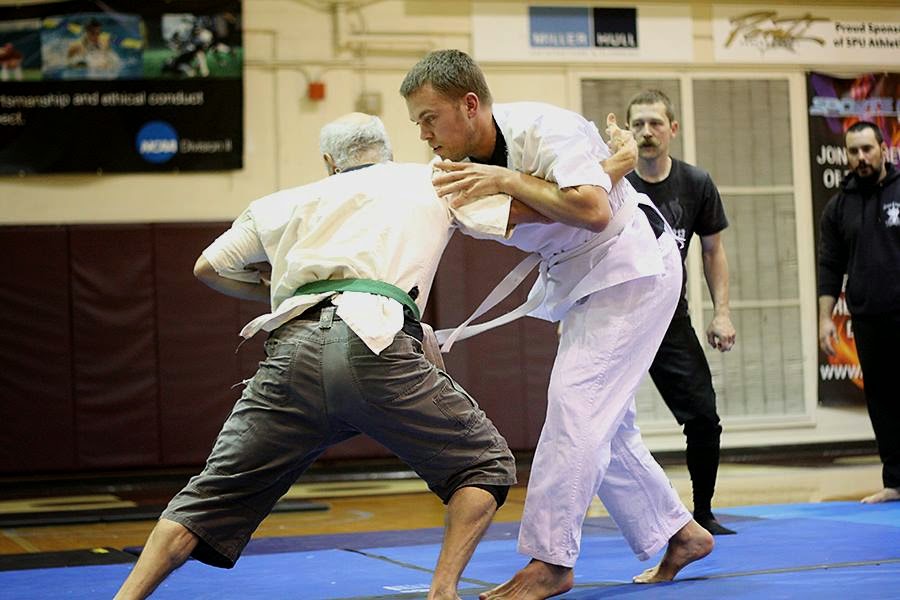
For those of you who know Tekki, I would defy you to find even a remote resemblance to any of the forms of sparring used in modern karate. The kata is concentrated in its feelings and movements. There are few thrusts and minimal kicking. Trying to understand Tekki based on free sparring was like trying to understand an apple by comparing it to a banana. Most of the movements in Tekki imply very close proximity to an opponent—close enough to already be touching.
I noticed other arts that had movements enticingly similar to Tekki. I compared Tekki to Wing Chun, particularly Wing Chun’s chi sao and economy of movement, and that taught me something. Tekki, though, is not strike-heavy, and Wing Chun is. I looked at weapons arts, specifically pencak silat and some of their dagger forms. I learned the methods of push hands from tai chi in order to give my Tekki meaning. All along, I began to relate Tekki not to distance-oriented fighting arts, but to wrestling.
I looked at the history of the kata and learned about karate’s early relationship to tegumi, Okinawa’s native grappling art. I learned that Itosu codified what was Naihanchi into three forms and taught them extensively in public schools to build a foundation. Funakoshi would later alter the name from Naihanchi to Tekki on the cusp of introducing these forms to mainland Japan.
Within karate, the Tekki forms vary in their execution from school to school. Indeed, it was not until the publication of kata in books that any real codification occurred. Prior to this, kata—all kata—were altered according to the understanding of the teacher or to accommodate a student’s capacity or size. So you see variations in the technical forms applied to Tekki. Thinking about this caused me to reconsider the idea that kata were inviolate images of some preconceived fighting methods. Instead, they became imperfect copies of past geniuses’ understanding, marred by misunderstanding and reiterated over and over. A crisis, then: what is the point of these things, warped by time and personalization as much as they seem to be? This warping over time is why Funakoshi wrote his books of kata. He created an image that froze the transformation of kata at the moment of his own best understanding, saying, perhaps, “Make your own forms based on these. That way, each student will start from the same point in the modification and evolution of the forms. What you build from there will be yours and yours alone and future generations will not suffer from continued interpretations of forms away from the source.”
I pondered the creation of kata as well. Who were these people who invented kata? Were they famous masters with notoriety, or were they simply one practitioner among many, inspired to document—somehow—how he fought and what was important to him? To answer that, I decided to make my own form. It was a spear form based roughly on the methods of Meyer from medieval Germany. I wanted the form to mimic how I actually fought. I wanted the form to be alive in that way.
I had seen Mr. Ono work on his sparring forms. I would catch a glimpse now and again of his progress. I think he worked on these for nearly a decade, and perhaps he is still doing so today. His forms were based directly on his own sparring experience. If you practiced these forms, you would begin to understand how the form emulated Ono himself.
This is what defines a living kata versus a dead one. A dead kata—or at least a kata in suspended animation—appears in books. A living kata is born from the soul of someone who had real experience in fighting or combat. The kata such a person creates resonates with the creator’s knowledge and vibrates with its truth. To take a kata from a book and resurrect it, you must breathe life back into it by taking what you think it is saying to you and then pressure-testing it under experimental conditions of real combat, proving to yourself: this is how I can use it.
That is what the study of kata is: repetition, history, comparison, synthesis, testing through fire, endless reiteration, and then—finally and ongoing—birth. If you do all that, you can say, “I brought life to this form,” and just maybe you will understand a little of the incredible people who created these gifts as well.
It is not my understanding of the form that is important here. You cannot understand what I learned through copying and repeating the form from any source. It is the journey that is worth emulating. The squeeze is worth the juice. The squeeze is the juice.

Leave a Reply